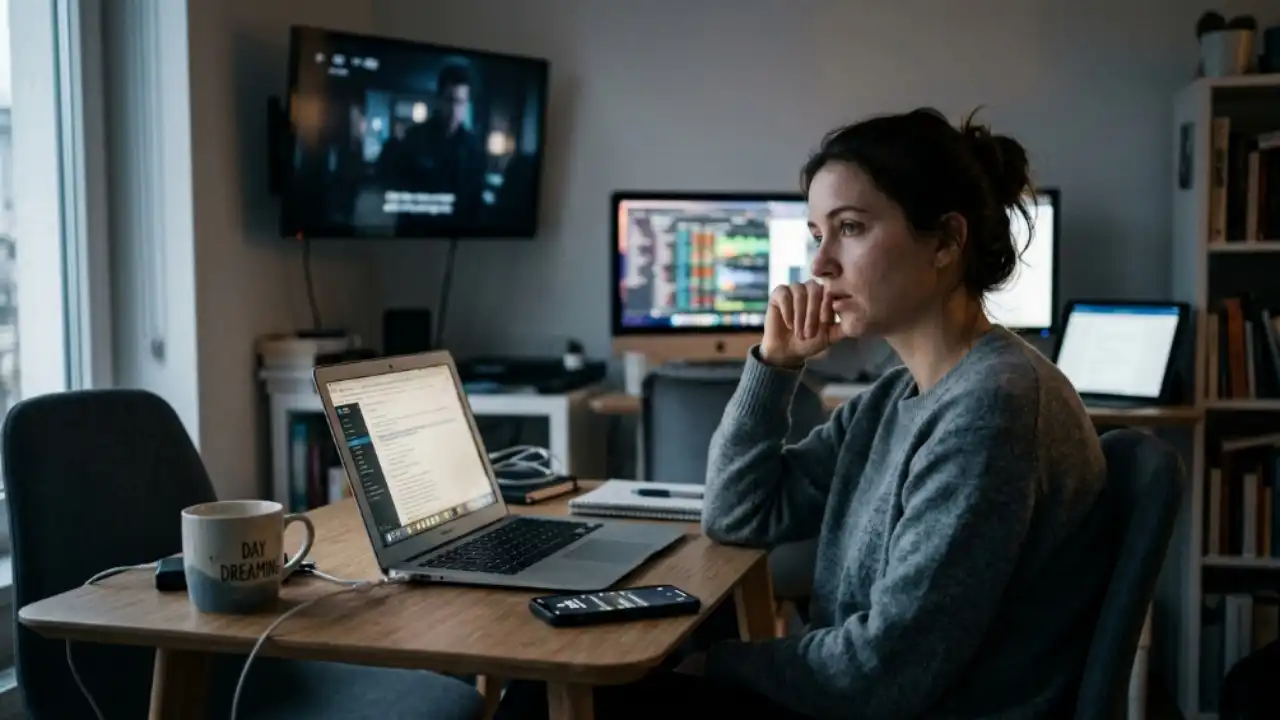
Focus feels harder today because the modern mind is rarely left alone with one task. Even when people sit quietly with a laptop, book, or notebook, invisible digital pressure often surrounds their attention.
A phone nearby can carry messages, alerts, work updates, news, entertainment, and social feedback at the same time. This creates a constant sense that something else may need attention.

The problem is not only distraction. The deeper issue is that digital life trains the brain to expect speed, novelty, and instant reward, while real focus usually requires patience, mental effort, and delayed results.
Table of Contents
The Brain Has Limited Attention
Human attention is powerful, but it is not unlimited. The brain must constantly decide what deserves focus and what should be ignored. This filtering process becomes harder when many signals arrive at once.
Digital tools increase this load by mixing important and unimportant information in the same space. A work message, a payment alert, a social media update, and a random video can all appear on one device.

This forces the brain to keep checking for relevance. Even when a person does not open the phone, the mind may remain partly alert to it. That small pull weakens deep attention.
Digital Novelty Keeps Pulling the Mind
The brain naturally notices new things. In human evolution, novelty could mean danger, food, social change, or opportunity. So the mind is built to react quickly when something fresh appears.
Digital platforms use this instinct very effectively. A new notification, short video, headline, comment, or suggested post gives the brain a small hit of fresh stimulation. Most of it is non-essential, but it still feels difficult to ignore.

This is why scrolling can feel easier than reading, studying, or writing. Scrolling offers quick changes with little effort. Focus asks the brain to stay with one thing long enough to build depth.
Why Work Feels Heavier After Interruptions
Focused work needs continuity. The brain must remember the goal, hold details in working memory, and move through the task step by step. This is why serious work often feels slow at the beginning.
A small interruption breaks that mental chain. After checking a message or changing tabs, the person returns to the same task, but the brain has to rebuild the context. That restart costs energy.
This phenomenon is one reason people feel tired even after a day that was not physically demanding. The task may not be extremely hard, but having to restart attention again and again makes it feel harder than it is.
The Hidden Cost of Task-Switching
Many people believe they are multitasking, but the brain usually switches between tasks rather than doing them simultaneously. It moves from a document to a message, from a message to a browser tab, and from there to a notification.
Each switch has a mental cost. The brain must leave one context and enter another. A work email needs a different mindset than a social feed, and a serious article needs a different kind of attention than a short video.
Common signs of task-switching overload include:
- Reading the same paragraph again because the mind did not absorb it
- Opening the phone without remembering the reason
- Feeling busy all day but completing very little deep work
- Avoiding serious tasks after many small interruptions
- Feeling mentally tired even after low-effort screen use
These signs are not always proof of laziness. They often show that attention has been divided too many times.
Short Content Trains the Brain to Expect Fast Rewards
Short-form content changes the brain’s reward expectation. A video can create surprise in seconds. A headline can create tension immediately. A social update provides quick emotional or social information.
Deep work is different. Reading a long article, solving a hard problem, writing a report, or studying a difficult subject may not feel rewarding at first. The reward comes later, after the brain has stayed with the task.
When the mind spends too much time with fast content, slow tasks begin to feel unusually boring. The task has not changed. The brain’s expectation for speed has changed.
Emotional Escape Makes Distraction Stronger
Focus is not only about thinking. It is also about handling discomfort. Serious tasks often bring boredom, uncertainty, pressure, self-doubt, or fear of poor performance.
Digital distraction provides quick emotional relief. A person stuck on a challenging paragraph can check messages. For a few minutes, someone anxious about work can scroll. The discomfort drops, so the brain learns that escape feels pleasurable.
This creates a repeating loop:
- A demanding task creates stress, boredom, or uncertainty.
- The person feels an urge to escape the discomfort.
- A digital distraction offers quick relief.
- The brain rewards the escape because the pressure reduces.
- Returning to the original task feels harder than before.
Over time, distraction becomes more than a habit. It becomes a way to regulate emotion, even if it damages productivity.
The Mind Stays Partly “On Call”
Modern life keeps many people reachable at all times. Work messages, family updates, banking alerts, social media notifications, and news updates can arrive at any moment.
This creates partial readiness. The brain does not fully settle because it expects a possible interruption. Even during rest, the mind may stay alert for the next signal.
The problem becomes more pronounced when work and entertainment occur on the same device. The same phone used for relaxation may also carry deadlines, pressure, comparison, and urgent communication.
Willpower Alone is Not Enough
Many people blame themselves when they cannot focus. They think they lack discipline. Sometimes discipline matters, but it is not the whole story.
Digital environments are designed to reduce friction for engagement. It is easy to open, refresh, swipe, tap, and continue. Stopping often requires more effort than continuing.
That is why willpower alone is a weak solution. A better approach is to reduce unnecessary triggers before they start competing for attention. Focus improves when the environment stops fighting the brain.
Focus Needs Mental Space
Deep attention requires space. The brain needs time to settle into one task without being pulled toward other options. This process is difficult when many apps, tabs, messages, and unfinished digital loops remain open.
Every unread message or pending alert can act like a small mental hook. The person may not consciously think about it, but the mind still carries a sense of something unfinished.
Reducing these hooks helps the brain stay with one task longer. A quieter environment does not make work effortless, but it lowers the mental cost of beginning and continuing.
Why This Matters Beyond Productivity
The focus problem is not only about getting more work done. It affects learning, memory, decision-making, emotional control, and relationships. A distracted mind often reacts faster but understands less deeply.
When attention becomes fragmented, people may become less patient with complexity. Long reading feels harder. Slow conversations feel less rewarding. Careful thinking feels uncomfortable.
This issue matters because many important parts of life require sustained attention. Understanding people, making good decisions, learning deeply, and solving difficult problems all require more than quick reactions.
How Attention Can Be Rebuilt
Focus can return, but usually through gradual retraining. The brain needs repeated practice staying with one task long enough to feel progress again.
At first, the process may feel uncomfortable. The mind may search for stimulation. Boredom may appear quickly. The urge to check something may feel automatic.
These reactions are not failures. They show that the attention system is adjusting. Focus becomes easier when the brain relearns that slow effort can also be rewarding.
A More Realistic Way to Understand Focus
Focus feels harder in the digital age because distractions constantly divert attention from the present task. The modern environment offers too many quick exits from effort, boredom, and uncertainty.
Technology itself is not the enemy. Digital tools can support learning, work, connection, and creativity. The problem begins when there are no boundaries around how often they interrupt the mind.
A focused life now requires intentional design. The brain still has the ability for deep attention, but it needs protection from constant digital noise. In a world built for interruption, focus is not just a skill. It is mental protection.